
With the acceleration of industrial modernization, titanium has been widely used across many fields due to its unique properties. Particularly in the development of the oil industry, titanium and titanium alloys have become essential materials in metal structures, holding an indispensable position.
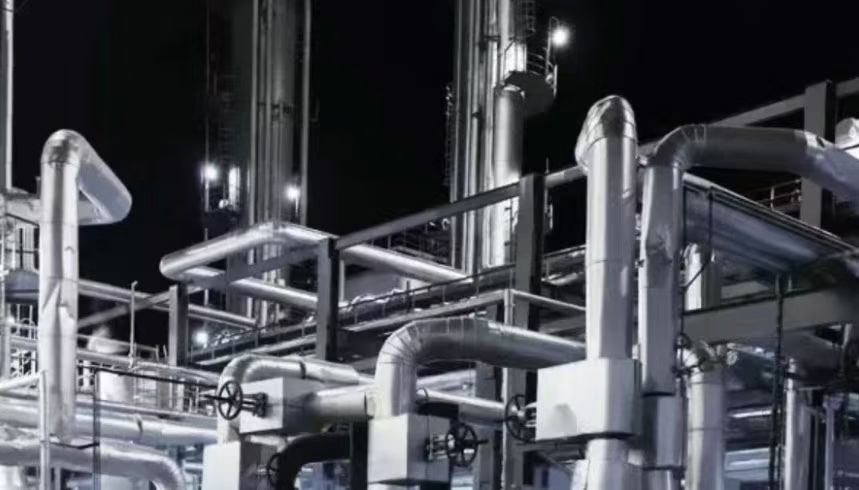
In the petrochemical sector, industrial pure titanium is extensively utilized in the manufacturing of various key equipment because of its excellent corrosion resistance and high strength.
Oil, the “blood” of modern industry, has brought high requirements for oil refining equipment while promoting social development. In the oil refining process, due to the diversity and corrosiveness of raw materials, the selection of equipment becomes particularly critical.
Titanium and titanium alloys, due to their excellent corrosion resistance, have gradually occupied an important position in the oil refining industry. In addition to drill pipes, offshore oil platform pillars, heat exchangers, pumps, valves, etc., are widely used in oil production and refining. The application history of titanium metal in the oil refining and chemical industry can be traced back to the early coolers.
With the advancement of science and technology, the application scope of titanium and its alloys has been continuously expanded, and now it has been widely used in key equipment such as heat exchange, condensation and cooling. These equipment are subjected to high temperature, high pressure and corrosive media during the refining process, and the excellent performance of titanium and titanium alloys is the best choice to meet these challenges.
Foreign countries have been using titanium equipment in the refining industry for nearly 40 years.
Due to the scarcity of oil resources, Japan mainly relies on imported high-sulfur crude oil, so it has accumulated rich experience in corrosion prevention. They use titanium alloy materials to solve the H2S-HCL-H2Ó environmental corrosion problem and have achieved remarkable results.
European and American countries also began to use titanium heat exchangers in refineries as early as the 1960s to meet the challenges of various corrosive media.
In China, although petrochemicals have always been a pillar industry, there are relatively few titanium equipment used in the refining industry.
However, with the rapid development of the economy and the rapid growth of demand for oil, especially the annual increase in the import volume of high-sulfur crude oil in the Middle East, China has put forward higher requirements for the technological transformation and upgrading of refining equipment.
Titanium and titanium alloys will become an indispensable and important material in the future refining industry due to their excellent corrosion resistance.