
In April 2026, a research team led by The Hong Kong Polytechnic University, in collaboration with the University of Sydney and other leading overseas universities, published a breakthrough in titanium alloy research in the internationally renowned journal Materials Today. The team successfully developed Ti-5Cu, a low-cost additively manufactured titanium alloy that achieves strength and toughness surpassing conventional aerospace titanium materials through an ultra-minimal alloy composition, offering a new technical solution for the low-cost, large-scale application and industrialization of additively manufactured titanium alloys worldwide.
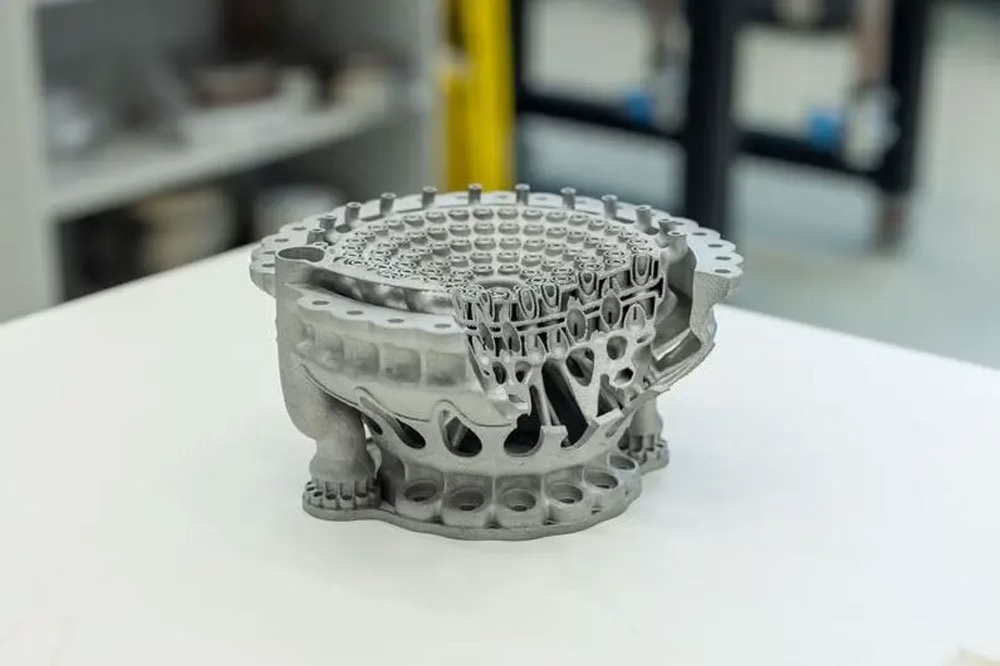
This study innovatively employed Laser Powder Bed Fusion (L-PBF), a mainstream additive manufacturing process, and abandoned the costly multi-element doping formulations used in traditional aerospace titanium alloys. By adding only 5% copper for alloy modification, it significantly reduced raw material preparation and melting costs, addressing the long-standing industry challenge of high production costs and difficulty in scaling up high-end 3D-printed titanium alloys. According to authoritative testing, the new Ti-5Cu titanium alloy achieves a tensile strength of 1,340 MPa with a stable elongation of 12%, with comprehensive strength-toughness metrics outperforming the globally standard aerospace-grade Ti-6Al-4V titanium alloy.
This new titanium alloy offers exceptional versatility and can be widely used in high-end applications such as lightweight aerospace structural components, high-end orthopedic implant medical devices, and precision machinery parts. It is also fully compatible with automated, large-scale 3D printing production workflows, delivering high forming precision and strong product consistency while balancing high performance with economic efficiency — shattering the long-held industry assumption that “high-performance titanium alloys must be expensive.”
The overseas research team stated that the technology has completed laboratory parameter optimization and small-batch prototyping, and will continue to advance process iteration and production-scale adaptation. It is expected to reach commercial deployment rapidly, empowering the global aerospace and medical titanium alloy industries to reduce costs, improve efficiency, and accelerate upgrading.
This overseas technological breakthrough opens a new pathway for the cost reduction of high-performance titanium alloys, driving the global transition of additively manufactured titanium alloys from niche high-end applications toward large-scale commercialization and compelling titanium manufacturers worldwide to accelerate their R&D in low-cost, high-value new titanium alloys.